
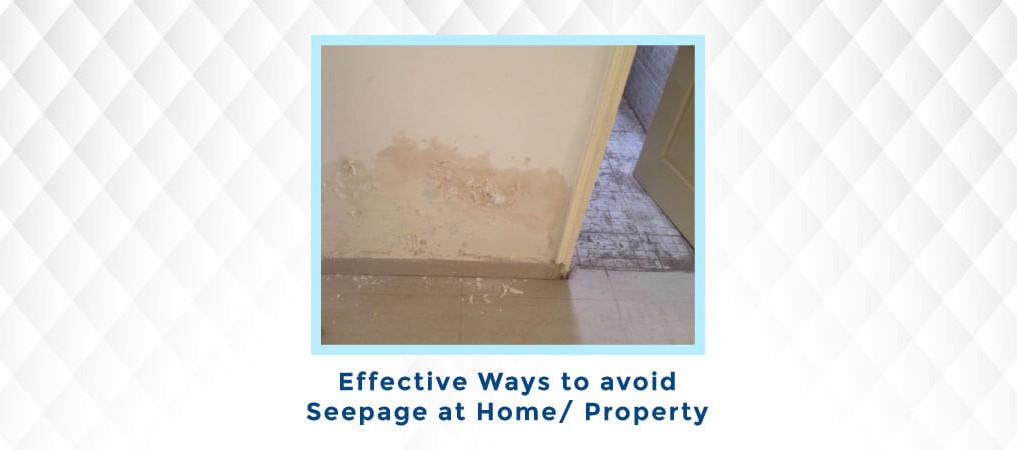
Effective Ways to avoid Seepage at Home/ Property
An important step towards a happy life is good health. And good health can only be achieved in a clean, hygienic and healthy environment. Seepage is a very common problem which the majority of Indian Households must have had experienced at some point of time. The moisture and dampness due to seepage can result in fungal and bacterial growth which in turn could cause various allergies and other health-related problems to the occupants of the home.
Ways to avoid seepage problems in your home
- Repair cracks on walls
Cracks are among the root causes of moisture in your home. Due to cracks at the external wall, rainwater and moisture will enter the wall surface thereby affecting adjacent / in-house wall surfaces and will weaken the integrity of associated elements. If cracks not treated at the right time, can increase in depth and lead to further deterioration in the affected area. So it is important to fix or repair the cracks to have long lasting homes1.
- Reduce indoor humidity
Sometimes we choose to dry laundry indoors. Drying it indoors is one of the causes which lead to humidity.And the kitchen is also a place in home, where steam gets generated due to cooking. One of the easiest way for reduced humidity is to keep your windows regularly opened and home well ventilated. Budget-friendly ways of getting rid of humidity & moisture in your home is by getting installed an exhaust fan, especially in your kitchen, bathroom and other household activity area where water is frequently used. But if you are still facing the problem of humidity, then you also can opt for a dehumidifier. Read How to Control Humidity in Your Home Using a Dehumidifier?
- Good-quality paints with specific property
If the paint on your wall is of inferior or poor quality, it tends to seep in moisture through concrete, which can damage the exterior and interior walls. This can result in weakening the strength of overall structure of your property and also make it appear unpleasant.Apart from good quality, it is an important point to keep in mind: interior or exterior areas need a specific type of paint. Different paints have different properties and are formulated for different purposes. For example: Exterior grade paints are used for exterior areas as they have resistance to cracking and dirt resistance, as well as provide protection from the damage ultraviolet (UV) rays cause.
